
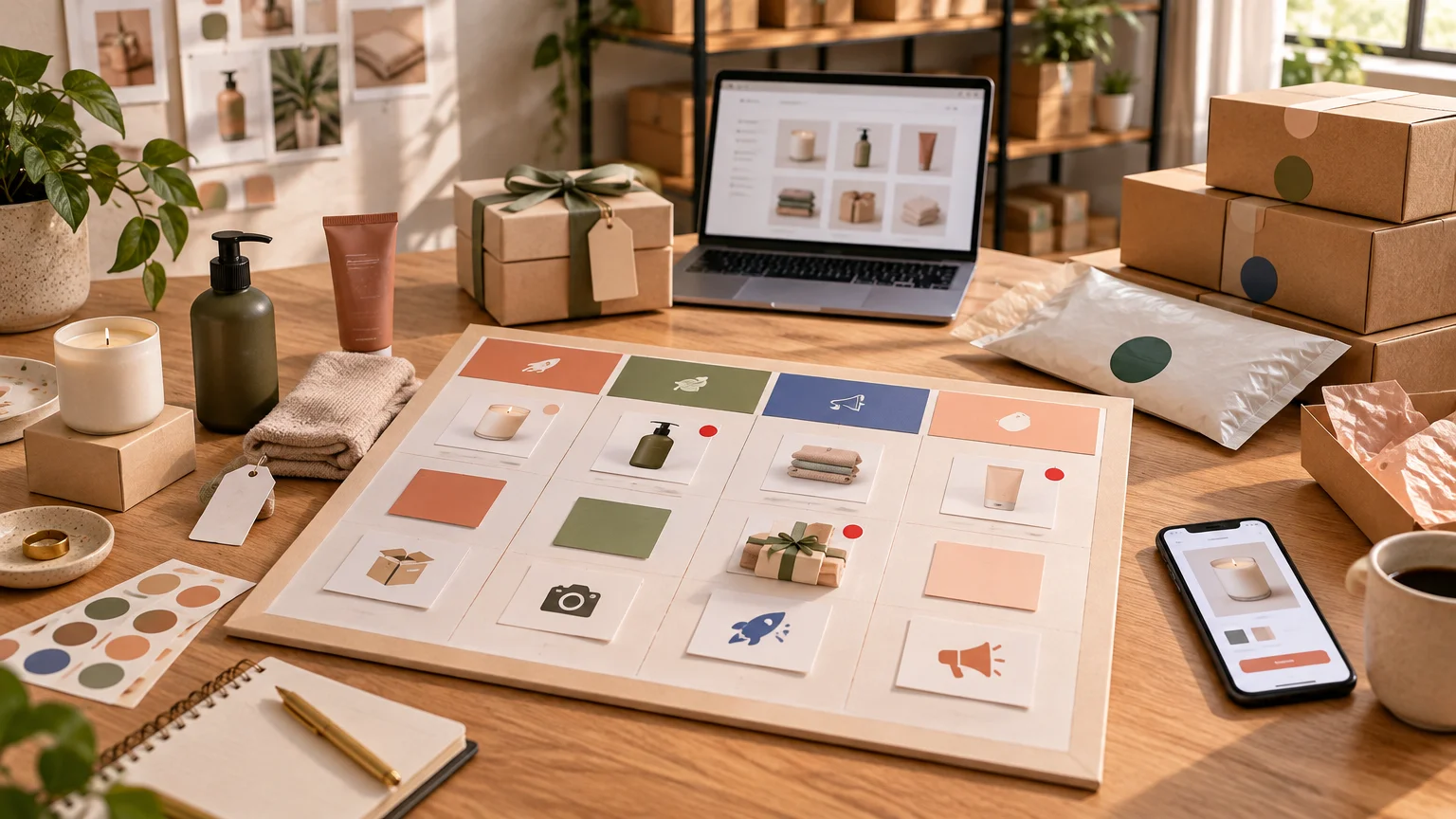
A useful ecommerce merchandising calendar is not a prettier marketing calendar. It is the operating plan that connects what you want to feature with what is available to sell, why customers should care, which assets must be ready, and what the business will do next.
For a small brand, the best structure is usually a rolling 12-week calendar supported by a lighter annual view. The annual layer captures major launches and seasonal moments. The rolling calendar turns those intentions into weekly decisions about products, inventory, channels, creative, offers, packaging, and measurement.
Start with merchandise, not holidays
Black Friday, Valentine’s Day, and the first day of summer are dates, not strategies. Start by listing the commercial events your store can realistically support. Most will fall into six categories: launches, restocks, seasonal moments, bundles, inventory interventions, and evergreen product stories.
| Moment type | Primary job | Planning question |
|---|---|---|
| Launch | Create demand for something new | Can product, content, inventory, and fulfillment go live together? |
| Restock | Convert existing demand | Which customers or wait-list segments should hear first? |
| Seasonal moment | Make the assortment timely | Does the product genuinely fit the occasion? |
| Bundle | Increase value or move complementary products | Are component inventory and margins workable? |
| Inventory intervention | Reduce aging or overstocked units | Can positioning change before discounting begins? |
| Evergreen story | Keep proven products visible | Which benefit, use case, or customer segment needs a fresh angle? |
This distinction prevents the familiar small-brand mistake of scheduling promotion after promotion without changing the merchandise story. A healthy calendar alternates reasons to pay attention: newness, availability, utility, curation, urgency, education, and proof.
Give every calendar entry the fields needed to execute
A row that says “summer campaign” is not ready for production. Each event needs enough information for marketing, inventory, site merchandising, and fulfillment to work from the same plan.
- Moment type and commercial objective
- Featured products, variants, collections, and markets
- Available units, inbound units, inventory age, and expected stock cover
- Offer structure, margin guardrails, and promotional dates
- Landing page, collection, search, navigation, and product-page changes
- Email, paid-social, creator, organic-social, and retention assets
- Packaging or insert requirements
- Owner, approval date, launch date, and contingency plan
- Promotion identifier and funnel metrics
- Post-event decision: replenish, extend, re-merchandise, bundle, relocate, or stop
Treat the asset list as part of the merchandise event rather than a separate creative request. A launch might need photography, short-form video, comparison copy, email, creator samples, a collection page, and a product launch email sequence. A restock may need only a wait-list message, fresh product-page proof, and a small retargeting push.
Let inventory change the plan
The calendar should respond to stock conditions instead of forcing every scheduled campaign to run unchanged. Shopify’s inventory reports include sell-through rate, days of inventory remaining, and days in inventory. Shopify defines sell-through as units sold divided by units sold plus ending inventory; its days-remaining estimate uses ending inventory and average daily unit sales over the preceding 28 days. These are estimates based on tracked inventory and recent sales, not promises of future demand.
Review those measures by SKU or variant before committing creative spend. A fast-selling item with limited cover may need a wait-list or restock story rather than broad acquisition. A slow-moving product should not automatically receive a discount. First test a new use case, stronger collection placement, a complementary pairing, or a better explanation of its value.
Bundles can help increase order value, curate a choice, improve product visibility, or clear older inventory. But they create operational dependencies. Shopify Bundles tracks overall bundle stock rather than stock by location, does not automatically update a bundle price when component prices change, and sends component SKUs through to the order. Check availability, pricing, channel support, and pick-pack instructions before putting a bundle on the calendar.
Plan in three production horizons
Not every week needs the same level of detail. Use three horizons so the calendar stays actionable without becoming a second full-time job.
- Weeks 9–12: Reserve inventory, define the offer, identify production needs, brief creators, and flag fulfillment changes.
- Weeks 5–8: Approve the assortment, produce assets, build pages, arrange samples, and confirm inbound stock.
- Weeks 1–4: Finish quality assurance, schedule publishing, load campaigns, verify tracking, and prepare customer-service responses.
Shopify supports future publishing for products, collections, pages, and blog posts, although products must be Active at the scheduled time and future publishing does not apply to the Shop app. Scheduled publishing can reduce launch-day work, but it does not replace a channel-by-channel readiness check.
Physical materials need their own lead time. If a campaign includes sample kits, package seals, QR labels, or reorder prompts, assign the artwork and ordering deadline alongside the digital assets. CustomStickers can be considered when the event requires custom stickers or labels. The broader packaging treatment should still match the campaign objective rather than becoming decoration with no measurable job; these branded packaging ideas provide a useful starting point.
Use a worked weekly sequence
Imagine a skincare brand planning a four-week spring event. Week one introduces a new cleanser to existing customers. Week two pairs it with a proven moisturizer in an educational routine. Week three releases a limited bundle using the same components. Week four shifts attention to customer proof and replenishment rather than adding another discount.
That sequence gives each week a distinct job while reusing core assets. It also preserves room to react. If the cleanser sells faster than expected, the brand can reduce prospecting, protect stock for existing customers, and replace the bundle push with a wait-list. If adoption is weak, it can test the product-page explanation or routine positioning before cutting price.
Measure events as funnels, not posts
Assign a consistent promotion name or ID across the relevant campaign links and ecommerce implementation. GA4 supports events such as item-list views, product selections, product views, add-to-cart actions, checkout steps, purchases, and refunds. Its ecommerce reporting can also distinguish event counts from item quantities for SKU-level analysis. Google’s recommended-event documentation explains the supported event structure.
Do not declare an event successful because a post received engagement, or unsuccessful because carts were abandoned. Baymard publishes a 70.19% cart-abandonment benchmark and notes that many shoppers abandon because they are browsing or are not ready to buy. That makes abandonment alone an incomplete verdict on merchandising performance. Baymard’s checkout research
Instead, compare product discovery, product views, cart additions, checkout progression, units sold, revenue, margin, refunds, new-customer mix, and remaining inventory. Then record an operating decision. Reporting describes what happened; your calendar should document what the team will change because of it.
Protect promotional pacing
Before finalizing each month, look at the calendar from the customer’s perspective. Three consecutive discounts can train shoppers to wait. Three launches in two weeks can exhaust the creative team and split demand. A restock promoted as newness can disappoint loyal customers who already know the product.
Aim for contrast. Follow a launch with education. Follow a broad seasonal moment with a targeted retention message. Use bundles selectively. Reserve discounts for a defined commercial purpose, and give evergreen winners space between louder events.
Build the first version this week
Create the annual view first, but limit it to major launches, known seasonal peaks, and inventory commitments. Then build the next 12 weeks in detail using the required fields above. Hold a short weekly review with marketing, operations, and whoever owns inventory.
The goal is not to predict every sale. It is to make fewer disconnected decisions. When merchandise, stock, content, channels, packaging, and measurement live in one calendar, a small brand can promote with more confidence—and change course before a campaign becomes an expensive commitment.
Frequently Asked Questions
What is an ecommerce merchandising calendar?
It is an operating plan that coordinates what the store will feature, available inventory, the customer reason to care, required assets, promotional timing, fulfillment needs, measurement, and the next decision.
How far ahead should a small ecommerce brand plan?
Use a light annual view for major launches, seasonal peaks, and inventory commitments, then manage the next 12 weeks in detail. Divide that rolling plan into preparation, production, and launch-readiness horizons.
What should every merchandising event include?
Record the objective, featured products, inventory position, offer and margin guardrails, site changes, channel assets, packaging needs, owners, deadlines, tracking identifier, contingency plan, and post-event decision.
How should inventory affect scheduled campaigns?
Check sell-through, days of inventory remaining, and inventory age before committing spend. Limited stock may call for a wait-list or targeted restock message, while slow stock may deserve new positioning, placement, or pairing before a discount.
When should a brand put a bundle on the calendar?
Use a bundle when it creates a clearer choice, increases order value, improves product visibility, or supports an inventory objective. Confirm component availability, pricing, channel support, and pick-pack instructions before launch.
How can a brand avoid excessive promotional pressure?
Create contrast between events. Follow launches with education, use bundles selectively, reserve discounts for defined commercial purposes, and give evergreen winners room between louder campaigns.
Which metrics should measure a merchandising event?
Track discovery, product views, cart additions, checkout progression, units sold, revenue, margin, refunds, customer mix, and remaining inventory. GA4 supports ecommerce events across that funnel and can separate event counts from item quantities.
What is the fastest way to build the first calendar?
Mark major annual commitments, build the next 12 weeks using consistent event fields, and hold a short weekly review with marketing, operations, and the inventory owner. End every review with a clear decision about what changes next.