
TLDR
For most growing brands evaluating custom poly mailers ecommerce options, the safest progression is plain mailers plus a branded sticker or interior insert first, followed by custom-printed mailers once order volume, product mix, packed dimensions, and fulfillment procedures are stable. A printed mailer can create a more cohesive arrival experience, but it cannot compensate for poor protection, slow packing, unreadable labels, or inventory that becomes obsolete after a redesign.
Use a poly mailer for lightweight, non-fragile products that do not need structural protection. Choose a padded mailer or corrugated box for products that are brittle, rigid, sharp-edged, crush-sensitive, or expensive enough to justify more protection. Before placing a large custom order, test the packed parcel through your actual fulfillment and carrier workflow.
The real decision is not custom versus plain
The useful question is whether branding belongs on the shipping container, inside the package, or in both places. That decision affects more than appearance. It changes purchasing commitments, storage requirements, packing instructions, return handling, and the brand’s ability to update a campaign without discarding packaging.
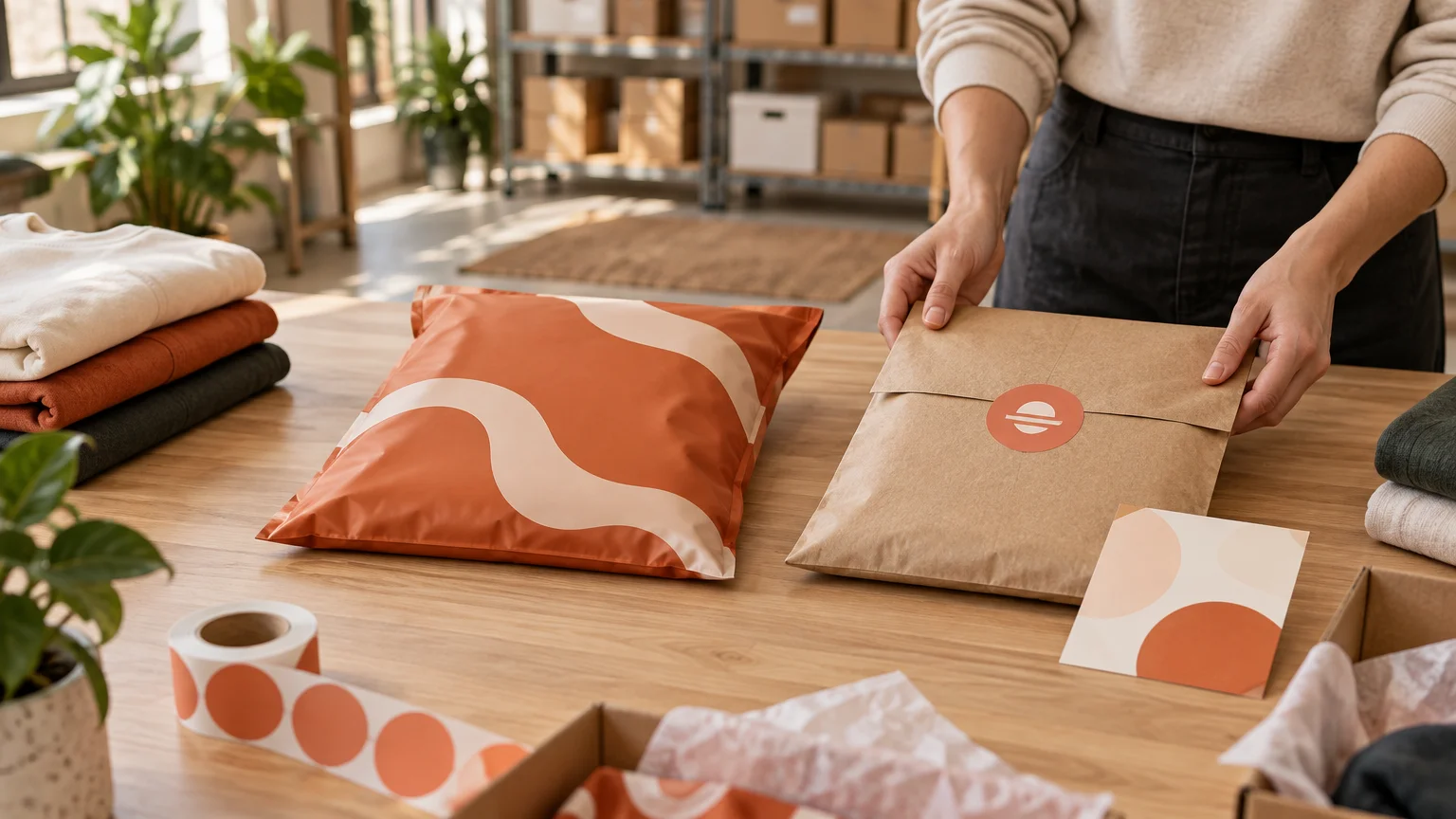
Custom poly mailers make sense when a brand repeatedly ships a narrow range of soft, durable products in predictable parcel sizes. Apparel, fabric accessories, and other compressible goods are common candidates. A full exterior print gives the package immediate visual identity without adding another pack-station step.
Plain mailers with branded interior packaging offer more flexibility. The same mailer inventory can serve multiple products, campaigns, wholesale accounts, or regional programs. A sticker, card, tissue seal, or QR insert can change independently. That makes this approach particularly useful for new stores, seasonal businesses, and brands still learning which parcel sizes they use most.
Shopify describes ecommerce packaging as both a protective system and a customer-facing brand touchpoint. That is a useful framing, but it does not prove that branded packaging will automatically increase repeat purchases or social sharing. Treat presentation as something to measure, not a guaranteed growth lever.
Custom poly mailers ecommerce options compared
| Format | Protection | Fulfillment impact | Branding flexibility | Best fit |
|---|---|---|---|---|
| Plain poly mailer plus sticker | Low; no cushioning or rigid support | Adds a sticker application step | High; stickers can change without replacing mailers | Early-stage brands, short campaigns, mixed products |
| One-color custom poly mailer | Low; depends on the mailer construction | Fast once stocked and documented | Moderate; artwork is fixed for the production run | Stable branding and repeatable shipment sizes |
| Full-color custom poly mailer | Low; print does not improve protection | Fast at the station but requires more artwork and inventory planning | Low during the run; high visual coverage | Established shipment profiles and durable creative |
| Padded mailer | Moderate cushioning but limited crush resistance | Simple when correctly sized | Varies by supplier and decorating method | Small products needing surface or impact protection |
| Corrugated box | Better structural and crush protection when specified correctly | Requires assembly, closure, and more storage | High through print, tape, stickers, tissue, and inserts | Fragile, rigid, premium, sharp-edged, or multi-item orders |
USPS identifies polywrap and bubble mailers as lightweight options for smaller, light items, while also requiring packages to withstand normal processing and handling. Its package and packaging guidance is a useful baseline, but the packed product—not the empty mailer—must survive the journey.
Do not assume that the lightest package always produces the lowest final shipping cost. Carrier pricing can depend on service, dimensions, weight, destination, surcharges, and commercial terms. USPS has also published updates affecting parcel pricing and dimensional treatment, reinforcing the need to rate-shop representative packed orders rather than rely on a universal mailer-versus-box claim.
When a poly mailer is the right shipping format
A poly mailer is a strong candidate when the product is flexible, lightweight, resistant to ordinary compression, and free of exposed edges that could puncture the film. The item should also tolerate being placed beneath heavier parcels during transit. Folded clothing may pass this test; a candle jar, framed print, collectible box, or structured handbag may not.
The product’s retail packaging matters too. A rigid retail carton placed inside a thin mailer can arrive dented even when the product remains functional. If the retail box is part of the value proposition, protect its appearance as well as its contents.
Move up to padding or a box when needed
- Use a padded mailer when a small item needs surface and light impact protection but does not require substantial crush resistance.
- Use a corrugated box when the product is fragile, rigid, sharp-edged, crush-sensitive, heavy relative to its size, or packed with multiple items that can collide.
- Add internal restraint when movement inside the package could cause scuffing or damage.
- Test edge cases such as the fullest order, the smallest order, bundles, returns, and parcels packed by a new team member.
Specify the mailer before designing it
A beautiful print file attached to the wrong bag is still the wrong packaging. Start with an operational specification built around actual packed orders.
- Measure packed dimensions. Measure the folded, bagged, or bundled product as it will reach the pack station—not an unwrapped sample laid flat.
- Assess fragility and puncture risk. Check corners, zippers, buckles, retail cartons, and any component that could press against the film.
- Choose the usable size and gusset. Allow enough room for consistent insertion and closure without buying a bag so large that products shift or the parcel becomes awkward.
- Review construction and opacity. Confirm that the mailer provides the privacy, durability, and visual coverage your products require. Do not publish a film gauge or construction claim without current supplier documentation.
- Test the adhesive closure. Evaluate seal consistency across realistic temperatures and packing conditions. If customers commonly return products, consider a separate return seal and simple instructions.
- Reserve a label-safe area. Keep a flat, high-contrast zone large enough for the shipping label and any required handling or return labels.
- Document supportable material claims. Obtain current evidence for recycled content, recyclability, compostability, or other environmental statements before printing them on the mailer.
Design for the pack station, not only the mockup
Mailer artwork is viewed flat during approval but folded, filled, wrinkled, labeled, and handled in use. Keep essential logos, instructions, and QR codes away from seams, flaps, gussets, and likely fold lines. Leave sufficient quiet space around scannable elements, and never make the shipping team hunt for a usable label position.
The label zone should remain readable across the range of products assigned to that mailer. A design may look balanced on a fully packed parcel yet collapse beneath the label when the same bag contains a smaller order. Test both conditions.
Approve a physical production proof or a small documented test order when available. Fill it with real products, apply the actual label, photograph each packing step, and send representative parcels through the intended delivery workflow. A screen proof cannot show how the material stretches, creases, seals, or behaves under a label.
A staged rollout limits expensive mistakes
Start with the lowest-commitment treatment capable of testing the idea. A plain stock mailer paired with custom packaging stickers can establish logo scale, color visibility, placement, and pack-time impact without locking the brand into a large quantity of printed mailers. If inserts, tape, and labels are also under consideration, this overview of branded packaging print ideas can help keep the system focused.
- Stage one: Validate the shipping format with plain mailers. Track damage, seal failures, delivery complaints, packing errors, and returns.
- Stage two: Add one flexible brand element, such as an exterior sticker, tissue seal, or interior card. Document exactly where it goes.
- Stage three: Test a standard-color or simple one-color mailer after the size and workflow are stable.
- Stage four: Consider a larger full-print order only when shipment volume, branding, parcel sizes, storage capacity, and cash flow support the commitment.
The plain-mailer approach can also separate two experiments. First determine whether the shipping format works. Then determine whether a branded treatment is operationally manageable and noticed by customers. Changing the bag, artwork, insert, packing method, and promotion simultaneously makes the results harder to interpret.
Compare total economics, not unit price alone
The decision should include the incremental packaging cost, labor, freight to your facility or fulfillment partner, storage, waste, and exposure to obsolete inventory. A lower quoted unit price can become expensive if it requires more stock than the brand can use before its artwork, sizing, or product mix changes.
Build the comparison around the number of orders expected to use the mailer. Calculate the additional packaging spend per eligible order, then include any change in average packing time. Model damage and return exposure separately rather than assuming a branded mailer changes either one.
Metrics worth tracking during the test
- Average packing time for eligible orders
- Seal failures and repacks before dispatch
- Damage complaints per shipped order
- Delivery complaints related to the package
- Return-processing time and return-mailer usability
- Packaging cost per shipped order, including added labels or inserts
- QR scans or offer redemptions tied to the packaging
- Customer feedback that specifically mentions packaging
- Repeat-order behavior for exposed and comparable unexposed groups, where sample size and tracking allow a responsible comparison
QR scans and survey comments can show engagement, but neither proves that packaging caused a later purchase. If retention is the business case, define the test group, comparison group, observation window, and offer before launch. Otherwise, regard the mailer primarily as a packaging and brand-consistency decision.
Be precise with environmental claims
Recycled content and recyclability are different claims. A mailer may contain recycled material without being widely recyclable through consumers’ local programs. It may also be technically recyclable in a specialized stream that many customers cannot access.
The FTC’s summary of the Green Guides warns against broad, unqualified environmental claims. Its guidance indicates that recyclability claims may need qualification when suitable facilities are not available to a substantial majority of consumers or communities. It also explains that partly recycled packages should disclose the relevant recycled-content percentage.
Avoid printing vague terms such as “eco-friendly” as a shortcut. Verify the specific construction, inks, adhesives, labels, and available collection route. Put any necessary qualification where customers can see and understand it; a distant webpage should not be expected to repair an overbroad statement printed prominently on the package.
The practical recommendation
Choose the shipping format before choosing the branding treatment. If a poly mailer protects the product, closes reliably, accepts labels cleanly, and moves efficiently through fulfillment, test branding at the smallest sensible commitment. For many growing stores, that means a plain mailer plus a sticker or insert.
Move to custom-printed mailers when the brand has repeatable parcel sizes, stable creative, predictable volume, adequate storage, and evidence that the workflow performs reliably. The goal is not merely a photogenic delivery. It is a package that protects the order, stays easy to pack, represents the brand clearly, and leaves enough operational flexibility for the next stage of growth.