
TLDR
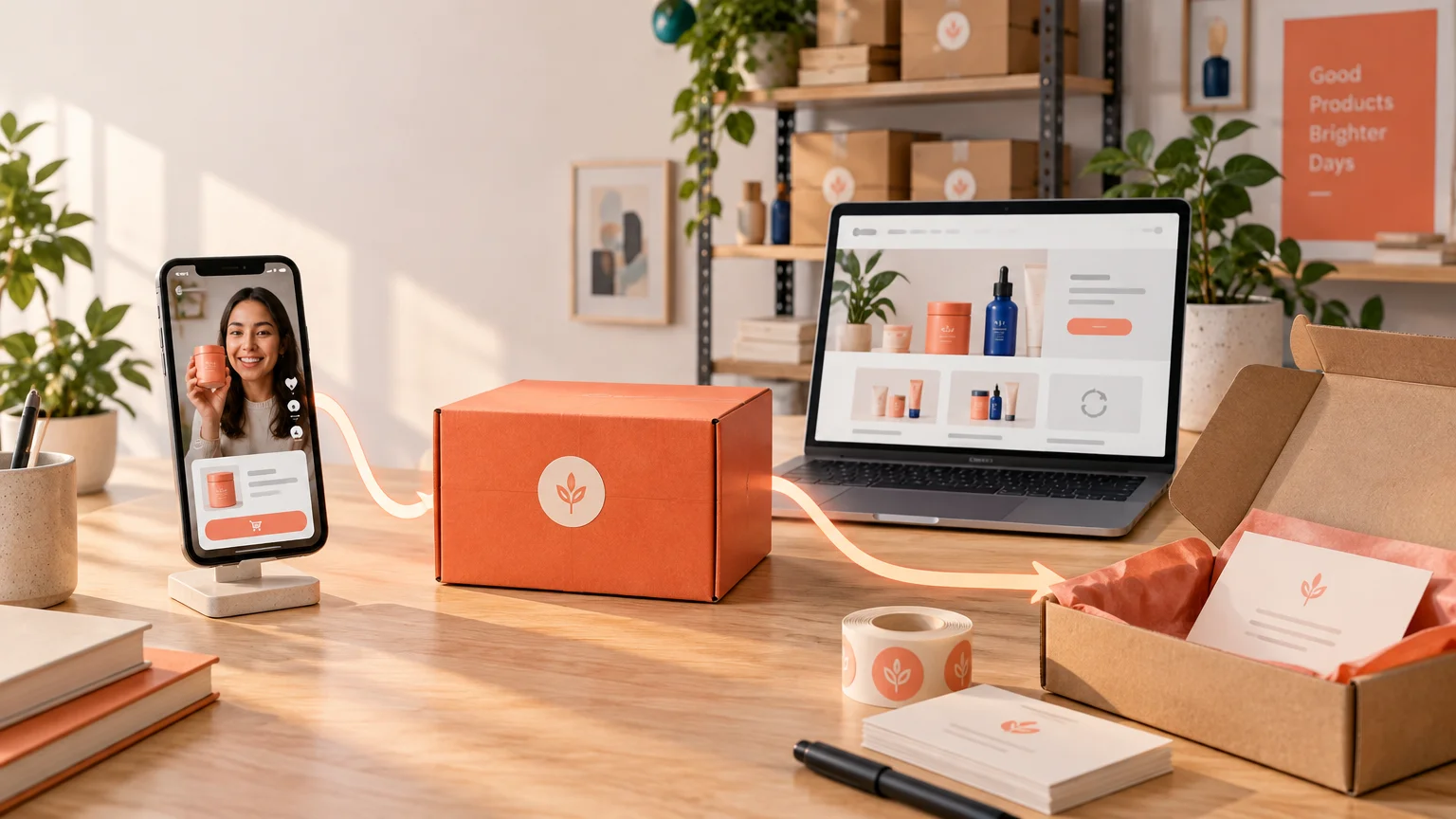
The TikTok Shop vs own website decision is rarely either-or. TikTok Shop is strongest when a creator or short video generates immediate demand for a simple, demonstrable product. Your website is stronger when shoppers need education, customization, bundles, subscriptions, or a deeper relationship with the brand. For many eligible brands, the best model is a focused TikTok Shop assortment feeding an owned-store retention system—with channel-specific margins and operations measured separately.
Treat the TikTok Shop vs own website question as a channel-design problem. Decide which channel should handle discovery, checkout, merchandising, fulfillment, and repeat purchase for each product. Do not choose based on gross sales alone: compare settled contribution margin, service performance, customer acquisition, and whether TikTok Shop orders are genuinely incremental.
TikTok Shop and your website do different jobs
TikTok Shop collapses discovery and checkout into the same social environment. A shopper can see a product demonstrated by a creator, tap the listing, and buy without following a conventional path through search, navigation, and a branded product page. That makes it attractive for products that can create desire quickly.
An owned store gives the brand more room and control. You can design the merchandising hierarchy, explain technical differences, collect consent directly, offer sophisticated bundles, and build post-purchase journeys around the customer's needs. The tradeoff is that every additional page, field, and decision can create friction. Baymard's checkout usability research documents how checkout design problems can undermine conversion on ecommerce sites.
That does not mean TikTok Shop automatically converts better. Conversion depends on the product, offer, audience, creative, trust signals, checkout experience, delivery promise, and price. It means TikTok Shop and an owned website begin from different contexts: one captures social momentum, while the other provides a controllable commerce environment.
| Decision area | TikTok Shop | Owned website |
|---|---|---|
| Discovery | Native to short-form content, affiliates, creators, and social browsing | Driven by sources such as search, paid media, email, direct traffic, referrals, and social clicks |
| Conversion path | Keeps an eligible purchase inside the TikTok environment | Requires the shopper to load and navigate the brand's storefront |
| Brand control | Constrained by platform formats, rules, and policies | Greater control over product education, presentation, checkout, and offers |
| Customer relationship | Marketplace customer information is subject to platform rules and consent requirements | The brand can build direct, consent-based email, SMS, and account relationships |
| Economics | May include referral fees, creator commissions, discounts, returns, and fulfillment costs | May include payment processing, apps, acquisition costs, hosting, returns, and fulfillment |
| Fulfillment | Must meet applicable TikTok Shop shipping, tracking, and service requirements | Brand defines its stack, carriers, service levels, and operational policies |
| Catalog fit | Best for eligible, easy-to-understand products with strong visual demonstrations | Better suited to broad catalogs, customization, education, bundles, and subscriptions |
| Repeat purchase | Possible, but the transaction does not automatically create an owned marketing relationship | More control over replenishment, loyalty, cross-selling, subscriptions, and lifecycle messaging |
When TikTok Shop should own the checkout
TikTok Shop is a strong candidate when the product's value is obvious in a short demonstration. Think visible transformations, satisfying use cases, clear before-and-after contrasts, giftable products, or items that prompt an immediate “I want that” response.
The best initial assortment is usually narrow. Start with one to five hero products that creators can explain accurately, operations can keep in stock, and customer support can handle without extensive consultation. A focused assortment also makes it easier to diagnose whether creative, price, reviews, inventory, or fulfillment is limiting performance.
- The product is eligible for sale and does not require an unsuitable approval or claims process.
- A creator can communicate the value and intended use quickly.
- Variants are limited enough to avoid selection mistakes.
- The unit economics can absorb applicable channel fees, creator commissions, discounts, and returns.
- Inventory and fulfillment teams can meet platform dispatch, tracking, delivery, and support requirements.
- The offer can stand alone without requiring several pages of education.
TikTok Shop is not merely another payment button. In the U.S., the platform documents category-based referral fees, prohibited and restricted product rules, and category approval requirements. Those details can change, so sellers should verify the current Seller Center policies before setting prices or committing campaign spend.
When your own store should remain primary
Send shoppers to an owned product page when the purchase benefits from depth. Higher-consideration products may need comparison charts, detailed specifications, compatibility information, extensive social proof, sizing tools, or a guided selection process. Complex catalogs also need navigation and filtering that a compact social listing may not reproduce.
An owned store is usually the better home for build-your-own bundles, subscriptions, replenishment programs, personalized products, wholesale inquiries, and cross-category merchandising. It also lets the brand connect the creative promise to the product page in a deliberate way. If that handoff is weak, use this framework for improving a product page receiving TikTok traffic.
Your website should also anchor retention. It can invite shoppers to join a loyalty program, manage a subscription, save preferences, view education, or consent to useful lifecycle messages. Those capabilities matter when the second or third purchase carries much of the customer value.
None of this guarantees a website sale will be more profitable. An owned transaction can still carry high paid-media costs, payment fees, app expenses, shipping subsidies, and support costs. Ownership creates flexibility; it does not remove the need for disciplined economics or checkout optimization.
Compare contribution margin, not headline revenue
Gross merchandise value can make a channel look healthy while discounts, commissions, shipping, returns, and service costs consume the order. Build a comparable order-level view for both channels.
A practical channel contribution formula is: customer payment minus product cost, pick-and-pack cost, packaging, outbound shipping subsidy, channel and payment fees, creator commission, brand-funded discounts, expected returns and refunds, and variable customer-support cost.
For an illustrative $50 order, suppose product cost is $12, fulfillment and packaging are $4, the shipping subsidy is $5, channel-related fees and commissions are $8, promotional funding is $3, and expected returns plus variable support cost $2. The settled contribution is $16. This is an example, not a TikTok Shop benchmark: substitute actual order and settlement data from each channel.
Use the same accounting boundaries on both sides. If website reporting includes payment processing but excludes paid acquisition, while TikTok reporting includes a creator commission but excludes internal content costs, the comparison is misleading. Track channel costs separately, then produce a second view that includes attributable acquisition expense.
Resolve eligibility and operations before launching
A viral clip is not an operating plan. TikTok Shop U.S. guidance identifies Seller Shipping, TikTok Shipping, and Fulfilled by TikTok as fulfillment paths, with applicable shipping, tracking, dispatch, delivery, and service requirements. Failures around fulfillment can lead to poor customer experiences and platform consequences, including cancellations in relevant circumstances.
Before creators publish, complete an operations readiness check:
- Confirm that every product and claim complies with the current prohibited, restricted, and category-specific listing rules.
- Choose the fulfillment path and document order cutoffs, dispatch ownership, carrier handoffs, tracking flow, and exception handling.
- Synchronize inventory or reserve channel stock so a burst of orders does not oversell units promised elsewhere.
- Test SKU, variant, and bundle mappings from the listing through the warehouse or fulfillment system.
- Set return, refund, cancellation, and customer-support workflows before volume arrives.
- Calculate capacity for a successful campaign, not just an average day.
- Review packaging dimensions and protection so the social-friendly offer remains economical and arrives in good condition.
A narrow launch protects both conversion and customer experience. It is better to fulfill two hero SKUs reliably than expose the entire catalog before inventory, variant mapping, and support workflows are ready.
A marketplace order is not automatically an owned audience
Do not assume a TikTok Shop buyer can be added to email or SMS marketing simply because the brand fulfilled the order. TikTok Shop's U.S. customer-service policy limits how seller customer information may be used, including use tied to fulfillment and relevant after-sales purposes; direct marketing requires legally valid prior consent.
The right retention strategy is to earn a voluntary next step. Packaging can invite the customer to register a product, access useful instructions, join a loyalty program, request replenishment reminders, or explore complementary products. Any email or SMS collection should clearly explain what the customer is joining and capture valid consent rather than quietly repurposing marketplace data.
A QR code on an insert can reduce the effort required to take that step, but the destination must provide real value. It should lead to a mobile-friendly page that matches the package promise. For practical execution ideas, see these branded packaging and insert options.
Run a 30-day channel test
A controlled test is more useful than debating which channel should win in theory. The goal is to learn whether TikTok Shop creates profitable incremental demand, supports the brand's service standards, and deserves a defined role beside the website.
- Choose one to five eligible hero products with reliable stock, clear demonstrations, and measurable margins.
- Document current website performance for those SKUs, including orders, settled contribution, conversion rate, returns, cancellations, and support contacts.
- Keep product definitions and core inventory stable during the test. If offers differ by channel, record the differences explicitly.
- Give creators accurate talking points, usage boundaries, and offer details. Define attribution and commission rules before publishing; creator codes alone do not prove who caused every sale, as this creator-code attribution guide explains.
- Monitor inventory, dispatch, tracking, cancellations, returns, refunds, customer contacts, and review themes daily—not only revenue.
- After 30 days, compare settled contribution per order and per 1,000 qualified views or visits, using consistent cost definitions.
- Look for incrementality. Compare total sales across both channels with a reasonable pre-test baseline, while noting promotions, seasonality, stockouts, and paid-media changes.
- Decide whether to expand the assortment, revise the offer, fix operations, or pause the channel.
Avoid forcing identical offers when the channels perform different jobs. TikTok Shop may need a simple hero bundle that makes sense in a short video, while the website carries the full range, customization, subscriptions, and deeper bundles. Maintain enough consistency to protect trust, but let each channel's merchandising reflect its buying context.
The practical recommendation
Prioritize TikTok Shop when the product is visually demonstrable, creator-friendly, operationally ready, and profitable after channel-specific costs. Prioritize your website when the purchase requires education, configuration, broad assortment access, or a sophisticated retention journey.
Use both when you can assign them clear roles. Let TikTok Shop capture social-native demand with a focused assortment. Let the owned store handle deeper merchandising, voluntary relationship building, and repeat-purchase systems. Measure both using settled contribution and service quality rather than declaring a winner from top-line sales.
The next step is simple: select one hero offer, verify current U.S. eligibility and fee rules, calculate its contribution margin for each channel, and pressure-test fulfillment. If the economics and operations hold, run the 30-day test. The best channel mix is the one that turns attention into profitable orders without sacrificing the customer experience that earns the next purchase.